All About Clergymen
When I was considering writing my first novel, I brainstormed a few ideas but was most struck by the thought of Mr. Darcy being a clergyman. I wondered how he would be the same Mr. Darcy we love and how it would change him. Soon, A Windmill with a View was born. Mr. Darcy is not the only clergyman in the book, and their various lifestyles play a prominent role in the story, which turned out to be more focused on Elizabeth’s journey than Mr. Darcy’s. She interacted with several men of the cloth and learned more herself about them. Therefore, I had the chance to learn all sorts of new information about the Church of England during the Regency era. I thought I would share just a little of that. Some of this is pretty basic, and readers of Austenesque fiction may know much of it. I thought it would be helpful to gather some of the details for my own future reference and hope you enjoy it.
A church living is a job that comes with a home and a paycheck. That home is a parsonage. It might also be called a rectory or a vicarage, depending on whether the clergyman is a rector or a vicar. The home was sometimes in serious disrepair, as evidenced by the parsonage Colonel Brandon is embarrassed to offer Edward Ferrars in Sense and Sensibility. The patron was responsible for the upkeep of the parsonage.
Both rectors and vicars, as well as curates, are fully ordained priests, usually. The different titles can most easily be explained as pertaining to how they are paid. The greater tithes went to the rector. The lesser tithes went to the vicar, if there was one. The curate is hired and paid by either a rector or a vicar and could receive very little money to do some or all of the work in the parish. The curate had no job security and was required to find his own home. When a rector or vicar retired (or took an additional living and moved away), he generally continued to collect the parish tithes and paid a curate a meager sum, such as £50 per year or even far less.
The rector could actually be non-clergy if the tithes were set up to go to someone else. Then a vicar would be hired to do the work of the parish but receive only the lesser tithes. In Pride and Prejudice, Mr. Collins is a rector in Hunsford. In A Windmill with a View, he is a vicar in a different parish.
Tithing, or ten percent of a person’s income, was required by law to be paid to the Church of England at the time Jane Austen wrote. This could be paid in the form of money or farm products. The greater tithes were from the cereal crops, or grains, which was apparently the majority of the income of an estate or tenant farmer. The lesser tithes were the income from the produce or livestock. By the early 1800s, most tithes were paid in money rather than goods, but the sources of the income still mattered. Since tithes were based on the harvest, a rector had no fixed income from year to year. A stated value of a living was an estimate. I cannot find the source now, but town parish priests received income from rented pews, perhaps in lieu of tithes, as there were no crops.
This is a complex system, but William Savage sums it up.
Rectors were the clergy who had the right to the whole income of the living and operated only under the supervision and control of the diocesan bishop. Vicars were formally ‘deputies’ to a rector, in cases where the rector was either unable or unwilling to serve the parish himself. This applied mostly where the rectorship was owned by an institution, such as an Oxford or Cambridge college, or by a lay-person. In such cases, the right to collect the full tithe lay with the rector, who would share it with the vicar in an agreed proportion.
But how did a man get a living and at what age?
Maria Grace gives a quick overview of the education required of a clergyman.
To be considered for ordination, a candidate needed a degree from Cambridge or Oxford. No theological colleges or courses of study existed so a standard honors degree satisfied the requirement. Afterwards, the candidate needed a testimonial from his college vouching for his fitness for ordination. Finally, he needed to locate a bishop and make arrangements for an examination that would satisfy the bishop of his competency in Latin, knowledge of the Scripture, and familiarity with the liturgy and church doctrine as written in the 39 Articles. Some bishops made only a cursory examination in these areas, only a few took their responsibilities more seriously…His career would begin at age 23, as a deacon, assisting an ordained priest. At 24 he could be fully ordained and eligible to be in charge of a parish.
In Sense and Sensibility, Edward Ferrars is 24 when he and Elinor Dashwood become engaged. He is taking orders about this time. I see no evidence that he served as a deacon for a year before taking the living Colonel Brandon gifts him, but he is of the required age. It is possible that Edward has been serving as a deacon with a lot of freedom of movement or several vacation periods, as he is in a few places for weeks at a time in this year. If he was working near Norland, it could account for why he was able to remain in the area for so long. I haven’t analyzed the timeline and am not a Sense and Sensibility scholar, but it is possible Jane Austen made allowances for Edward to serve his time as a deacon, perhaps starting before he met Elinor.
In reviewing my previous research, however, I was curious about something so searched again down another path and found something new. A man could get an exception from being a deacon and go straight to being fully ordained at age 24 and able to administer sacraments, but this required permission from the Archbishop of Canterbury, which Edward Ferrars was unlikely to have requested. These rules were set forth in the Clergy Ordination Act of 1804. I do not see in that Act any requirement to do anything as a deacon or to be a deacon for a full year before becoming a priest after he turned 24.
Perhaps Edward was a deacon at some point but did not assist a priest. We should also keep in mind that Jane Austen wrote her first draft of Sense and Sensibility in 1795, so perhaps there was no deacon requirement at the time and she saw no reason to add it in later drafts. Whether Edward was a deacon or not has little bearing on her story, but I am curious about whether he had taken that step toward a profession around the time he met Elinor. To me, it seemed he continued to be aimless until the truth came out and he thought he would be forced to provide for Lucy Steele.
Then I found in the Church’s 1604 Canons that there were just four times each year when men could be ordained. I have not learned whether this was still the case in the late 1700s and early 1800s or what those four times of year were. Perhaps the same quarter days used for so many other legal systems at the time. And even more interesting in the 1604 Canons: “None to be made Deacon and Minister both in one day.” A man had to be a deacon for at least three months, then, but not necessarily for a full year.
The 1604 Canons elaborate on this requirement:
Not that always every Deacon should be kept from the Ministry for a whole year, when the Bishop shall find good cause to the contrary; but that there being now four times appointed in every year for the Ordination of Deacons and Ministers, there may ever be some time of trial of their behaviour in the office of Deacon, before they be admitted to the order of Priesthood.
In any case, in A Windmill with a View, Mr. Darcy is a deacon serving under a rector for a year before taking on his own parish at age 24.
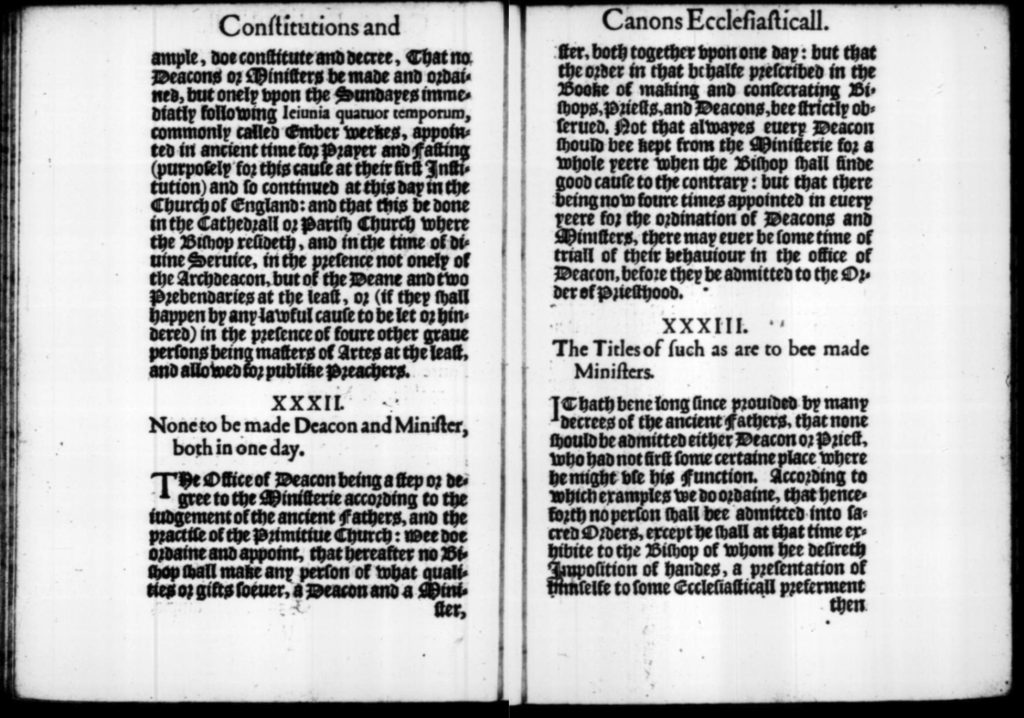
Looking at church laws from 1604 can be a bad idea, as I have found it difficult to hunt down more recent rules on the same topics to confirm whether the rules are still in place. For example, the 1604 Canons say a man must have a living granted to him before he can be ordained.
The 1604 Canons say a man
can’t take orders without proof they have a job offer, is a Fellow at Oxford or Cambridge, or has had a Master of Arts degree for five years and lives at one of the universities, or if the Bishop who ordains is about to give him a benefice or curateship “then void”.
Records from the 1800s, though, contradict that rule, so it must have been repealed at some point. Perhaps it shouldn’t have been? Once ordained, a priest was far from guaranteed he would ever find a job in his chosen profession. Apparently, fewer than half obtained a living. Those who did were chosen by a patron who held an advowson.
An advowson is the right to grant a church living. An advowson could be held by a private person, a college/university, or the church itself. One source indicated the Crown could also hold an advowson. A church living could be given or sold to a priest. This living would then be held for life. Only grievous reasons could cause a bishop to take it away. Mr. Collins did not need to work so hard to please Lady Catherine, as she could make his life difficult (which she does), but she could not oust him from his position.
In Pride and Prejudice, George Wickham was granted a living (by his godfather, Mr. Darcy, who held the advowson for the Kympton living) but gave it up, or sold it back to the younger Mr. Darcy (who now held the advowson since his father died), for £3,000. Mr. Darcy probably had no legal responsibility to pay Wickham, as nothing binding giving Wickham the living was likely to have been formalized, since Wickham had not taken orders. Someone holding an advowson could save a living for a child not yet old enough to take orders, and maybe contracts were drawn up to formalize this. I did not find any evidence of this in my research. If they did want to preserve the living for a future cleric, they could grant the living temporarily to another. In Sense and Sensibility, John Dashwood says Colonel Brandon could have sold the living under his control for £1,400 pounds rather than simply giving it to Edward Ferrars. The living was said to be worth £200 pounds per year.
This leads to another important question. The acceptable genteel professions for a younger son of a gentleman were military, law, and the church. None of these were expected to bring in an income equal to the heir’s, but was it still livable?
Maria Grace summarizes the question of a clergyman’s income.
The majority of England’s parishes were small. An 1802 figure suggests a third of the benefices brought in less than £150 a year and some 1,000 of those less than £100. (Remember, about £50 a year was more or less equivalent to our minimum wage.) A clergyman needed a living of £300-400 per annum to be on the level with the lesser gentry. Incomes might be increased by serving more than one parish, but this seldom resulted in real wealth. Only a third of all clergy acquired more than one living…Additional income might also be found through teaching or cultivating gardens and the glebe (acreage provided by the parish.)
James Heldman points out in a JASNA essay that Jane Austen does not dwell on income for her clergymen.
Edmund Bertram’s income from the Mansfield living, once he succeeds to it, is £700 a year…But Edmund is, after all, the younger son of Sir Thomas Bertram, and there seems little question that both Sir Thomas and eventually Tom, when he inherits the baronetcy, will see that Edmund and Fanny are more than amply provided for. In all of these novels, the central characters are generally already financially comfortable, and what references to money these novels do contain seem to be there only to establish that fact in order that Jane Austen can then move on to other matters.
For example, Henry Tilney in Northanger Abbey has a family living at Woodston but also extra income from his father: “Did Henry’s income depend solely on this living, he would not be ill-provided for.” Henry has enough income that he has a curate. We can also assume Catherine Morland’s father does sufficiently well for his ten children (though not good enough for the Thorpes and General Tilney) because “he had an independence besides two good livings.”
In A Windmill with a View, clergymen fall all over the spectrum as far as their income is concerned. Elizabeth Bennet begins her journey as a clergyman’s wife with a substantially lower income than she anticipates. Read the book to see how she manages a lifestyle very different from the one she was used to at Longbourn.
Resources:
- Clergy Ordination Act 1804, 1804 CHAPTER 43 44 Geo 3, https://www.legislation.gov.uk/ukpga/Geo3/44/43
- Constitutions and Canons Ecclesiastical, of the Church of England, 1604. #31-39. https://archive.org/details/bim_early-english-books-1475-1640_constitutions-and-canons_england-church-of-const_1604_0/mode/2up
- Grace, Maria. It’s a (church) living. https://randombitsoffascination.com/2012/01/26/its-a-church-living/
- Grace, Maria. Taking orders. https://randombitsoffascination.com/2012/02/08/taking-orders/
- Heldman, James. “How Wealthy is Mr. Darcy – Really?: Pounds and Dollars in the World of Pride and Prejudice.” Persuasions #12, (JASNA, 1990), p38-49.
- Jennings, Anthony & Clive Aslet. The Old Rectory: The Story of The English Parsonage, p36. https://www.scribd.com/document/284854089/Jennings-Anthony-Clive-Aslet-The-Old-Rectory-The-Story-of-the-English-Parsonage#page=23
- Savage, William. The Georgian Clergy (Part 1). https://penandpension.com/2018/05/16/the-georgian-clergy-part-1/#:~:text=Most%20curates%20were%20either%20young,the%20catechism%20and%20Sunday%20School
Discover more from Author Kelona Salway
Subscribe to get the latest posts sent to your email.